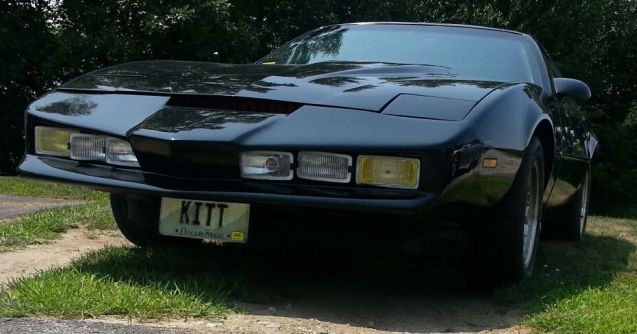
KITT wasn't just a car with gadgets. He was a mobile command center. Every surface did something. Every button had a purpose. Building that from scratch means thinking the same way — not what looks cool, but what works, and what works together.
The media and electronics layer of this build is where the show car meets the street car. Some of it is period hardware chosen because it belongs to the same era as the original prop. Some of it is custom logic that didn't exist in 1982 and had to be built. All of it is intentional.
The JVC KV-V10 is the video source — an in-car VCR from the era when putting a tape deck in a dashboard was the leading edge of mobile entertainment technology. KITT had screens. This car has screens. The KV-V10 feeds them. It's documented in the Sound System chapter as part of the source chain; it earns its own entry here because it's as much about the visual system as the audio one.
The Uniden CP-1200 is an analog cellular phone — a genuine period-correct car phone from the days before digital networks made these obsolete. KITT had a phone. Devon called. Michael answered. This one is the real hardware from that window in time, not a prop replica. It works the way it always worked, which is to say it worked on a network that no longer exists — but it's here, and it's right.
The Clifford alarm SMS controller module handles security and remote system control via SMS. It's the one concession to modern infrastructure in this section — Clifford built serious alarm and remote-start hardware, and the SMS module bridges the car's security layer to a phone in a pocket rather than a pager on a belt. KITT looked after himself. So does this car.
The Alpha decoder is where the build gets custom. It takes keypad input and decodes it into 16-segment display output for the microprocessor unit on the dash. Sixteen-segment displays are the alphanumeric version of the seven-segment digits most people recognize — they can render full letters, not just numbers. The MPU reads the keypad, the decoder translates, the display responds. That's the KITT voice box logic running in real hardware, not simulated on a screen.
The amplifier motor driver drives the amplifier draw lines for visual presentation — translating the audio system's power consumption into a signal that feeds the dash displays. When the system is working, the dash shows it. The needles move because the music is playing. It's not decorative. It's honest instrumentation, the same philosophy the original designers used when they put a voice modulator on the dash instead of a static light bar.
Media and electronics components:
| Video Source | JVC KV-V10 in-car VCR |
| Cellular | Uniden CP-1200 analog car phone |
| Security / Remote | Clifford alarm SMS controller module |
| Dash Interface | Alpha decoder — keypad to 16-segment display decoding for dash MPU |
| Visual Metering | Amplifier motor driver — drives amp draw lines for visual presentation |
More detail on the dash MPU, the display logic, and the full wiring architecture will be documented here as the build record expands. The custom electronics in this car are some of the most technically involved work in the whole project — they deserve their own deep-dive, and they'll get one.
This is the system that makes the car feel alive. Not the engine. This.