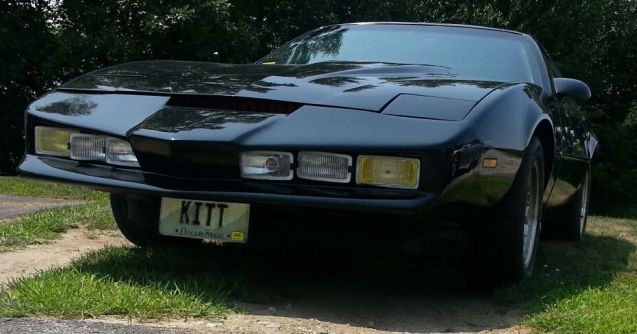
The scanner is the car. Everything else — the sound system, the dash electronics, the custom bodywork — exists in the context of what people see moving across that nose. Get the scanner wrong and none of the rest of it matters. Get it right and people stop walking.
This one is built by Mark's Custom Kits, and it's not running stock out of the box. The sequencing was tweaked specifically to nail the one detail most replica scanners miss: the pause at the endpoints. Watch the show carefully and you'll see it — the sweep doesn't reverse instantly at each end. It hesitates. Just a beat. Then comes back. That moment of hesitation is what makes it feel like something is thinking rather than something is looping. Getting that pause right in hardware timing is the difference between a prop and a replica.
The scanner uses 1156 incandescent bulbs — not LEDs. That's a deliberate choice and it's the right one. When an incandescent filament cuts power, it doesn't go dark instantly. The filament cools. The glow fades. That trailing decay is exactly what gives the KITT scanner its sense of life — the illusion that the light has weight, that it's sweeping through space rather than flashing on and off. You cannot fake that in software as convincingly as physics does it for free. The filaments do the work.
The bar itself is aluminum, acting as the ground plane for the bulb circuit. A plexiglass slide plate sits over the assembly, color-matched to the red used in the show. The combination gives the correct depth and hue under the lens — not just red, but the right red, with the right amount of diffusion behind it.
Scanner speed is fully adjustable, running from as slow as 2 seconds per bulb up to nearly two complete sweeps per second. That range covers everything from a slow, dramatic idle sweep to a full-speed scan that reads as urgent without looking mechanical. Speed control and on/off are handled entirely from the overhead console — no reaching, no distraction, exactly where a system like this belongs.
The control LEDs are remoted into the teardrop hood scoop where the driver can see them directly from the seat. Glance up through the windshield and the indicator steps in real time, 1:1 with the scanner bar — so you can watch the sweep rhythm while you're driving and dial the speed in visually without pulling over or guessing. The scoop puts the feedback exactly where it needs to be: in the driver's sightline, not buried in a console.
There is no sweep sound. The show used one. This car doesn't. The decision is deliberate — an audible sweep tone that triggers every time the scanner runs creates real problems in the real world. Police responses, public confusion, general nuisance in parking lots and car shows. The visual does the job on its own. Anyone who's seen the scanner running in person hasn't missed it.
Scanner specifications:
| Unit | Mark's Custom Kits scanner |
| Bulb Type | 1156 incandescent — filament decay provides natural scan trail |
| Bar Construction | Aluminum housing, acts as bulb ground plane |
| Lens | Plexiglass slide plate, color-matched to Knight Rider red |
| Sequencing | Custom-tuned — endpoint pause on sweep reversal |
| Speed Range | 2 seconds per bulb (slow) to ~2 full sweeps per second (fast) |
| Controls | Speed and on/off from overhead console |
| Remote Indicator | Control LEDs remoted to teardrop hood scoop — visible from driver's seat in real time |
| Audio | No sweep sound — intentional omission |
Most people see the scanner and think they know what they're looking at. They're seeing a red light moving back and forth. What they're actually seeing is a timing circuit, a heat-physics decay curve, a carefully tuned pause, and thirty-plus years of one show's iconography distilled into a strip of aluminum bolted to the nose of a 1990 Firebird.
It works because every decision behind it was made on purpose.